Advanced Kids Robotics Course in Sri Lanka 2026: Level 2 - Master Robotics Programming | රොබෝ තාක්ෂණ උසස් පාඨමාලාව - Level 2
Eng S Wimaladasa
Advanced Robotics Specialist
English Version
📖 16-Day Complete Syllabus - Each day includes Theory, Lab Exercises, Practical Work, and Hands-on Projects
The Next Step in Kids Robotics Education in Sri Lanka
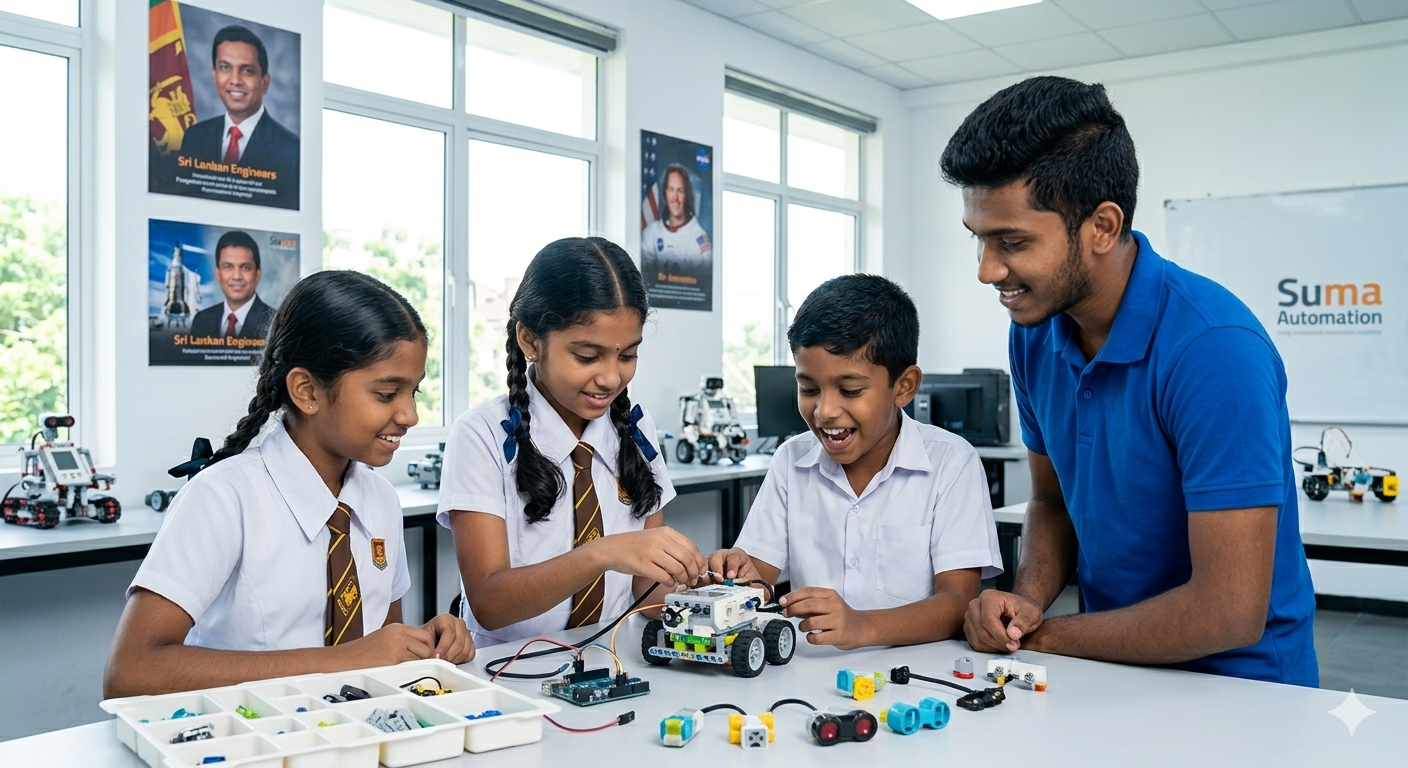
For children who have successfully completed Level 1, Suma Automation Kids Robotics Level 2 is designed to take their robotics knowledge to the next level. This 16-day intensive program is specially designed for Grades 6-9 students.
In Level 2, children will learn advanced C programming, sensor integration, Bluetooth control, and build a complete line follower robot. As a final project, they will design and present their own smart robot.
Why Should Your Child Take Level 2 Robotics?
Advanced Technical Knowledge
Build on Level 1 fundamentals with advanced C programming, PWM control, multiple sensor integration, and complex decision-making algorithms.
Line Follower Robot Building
Design and build a complete line follower robot as the final project. This is a key skill for robotics competitions and exhibitions.
Bluetooth & Wireless Control
Learn to control robots wirelessly using smartphones. This introduces basic IoT (Internet of Things) concepts.
Competition Preparation
Gain the knowledge and experience needed for school-level robotics competitions, STEM fairs, and national-level events.
Our Teaching Methodology
100% Hands-on - Project-Based Learning
16-Day Intensive Program
Monday to Friday, 9:00 AM to 12:00 PM daily. Total 48 hours of hands-on practical training.
Small Class Sizes
Maximum 15 students per batch. Each child gets their own advanced Arduino kit and equipment.
Final Exhibition Day
At the end of the course, a robot exhibition and competition is held for parents. Certificate ceremony is also conducted on this day.
Key Features:
- One advanced Arduino kit per child
- All electronic components and sensors provided
- Bluetooth module included
- Advanced C programming training
- Take home your own robot at the end
- Competition and exhibition preparation
Advanced Equipment We Use
Specially designed advanced robotics kits for Level 2:
Advanced Arduino Kits
Items: Arduino UNO R3, Arduino Mega 2560, LCD 16x2 Display, RGB LED Modules, NeoPixel LED Strip
More advanced components than Level 1. Capability to integrate multiple sensors and I/O devices.
Advanced Motor Control
Items: L298N Motor Driver, L293D Motor Driver, Servo Motors (SG90, MG995), DC Gear Motors, Stepper Motor
Powerful motor drivers and precise servo motors. Perfect for line follower and obstacle avoidance robots.
Advanced Sensors
Items: IR Line Sensor Array, Ultrasonic Sensor HC-SR04, PIR Motion Sensor, DHT11 Temperature Sensor, LDR Light Sensor, Sound Sensor, Proximity Sensor
IR sensor array for line following, ultrasonic for obstacle detection, and other environmental sensors.
Wireless Communication
Items: Bluetooth Module HC-05/HC-06, RF 433MHz Modules, ESP8266 WiFi Module
Control robots using smartphones. Introduction to IoT concepts.
Robot Frames & Mechanical Parts
Items: Aluminum Robot Chassis, 4x DC Gear Motors, Wheels with Encoders, Castor Wheel, Mounting Brackets, Battery Holder
Strong aluminum frames, wheels with encoders, and professional-grade mounting hardware.
16-Day Complete Advanced Syllabus
📅 1. Introduction to Robotics & Microcontrollers
📚 Theory & Concepts
What is Robotics? (120 min)
- Introduction to robotics, real-world applications
- Learning Objectives: Understand robotics, See real examples, Basic concepts
Microcontrollers Explained (120 min)
- Arduino, Raspberry Pi, Micro:bit comparison
- Learning Objectives: Types of microcontrollers, Arduino advantages, Educational use
🔧 Practical Work
Arduino Uno Setup (120 min)
- Getting started with Arduino IDE
- Objectives: IDE installation, Board setup, Basic connection
🤖 Hands-on Project
First Program - LED Blink (90 min)
- Write and upload first Arduino program
- Objectives: Write simple code, Upload to board, See physical result
📅 2. LED Control & C-Programming Basics
📚 Theory & Concepts
Arduino Program Structure (120 min)
- setup() and loop() functions
- Learning Objectives: Program structure, Function purpose, Basic syntax
C Programming Introduction (120 min)
- Basic C concepts for Arduino
- Learning Objectives: C basics, Syntax rules, Simple commands
🔧 Practical Work
LED Pattern Creation (120 min)
- Create different LED blinking patterns
- Objectives: Multiple patterns, Delay control, Creative coding
🤖 Hands-on Project
LED Morse Code (90 min)
- Send SOS signal using LED
- Objectives: Pattern timing, Real application, Problem solving
📅 3. Variables & Logic Building
📚 Theory & Concepts
Understanding Variables (120 min)
- Why we need memory in programs
- Learning Objectives: Variable concept, Memory usage, Data storage
Data Types in C (120 min)
- int, float, char data types
- Learning Objectives: Different data types, When to use each, Type rules
🔧 Practical Work
Variable Practice (120 min)
- Using variables to control LED timing
- Objectives: Declare variables, Use in programs, Dynamic control
🤖 Hands-on Project
Speed Controller (90 min)
- Control LED blink speed with variables
- Objectives: Variable manipulation, Speed control, User input
📅 4. Seven-Segment Display
📚 Theory & Concepts
Display Technology (120 min)
- How seven-segment displays work
- Learning Objectives: Display原理, Segment control, Number formation
BCD Decoder IC (120 min)
- CD4511 decoder introduction
- Learning Objectives: IC purpose, Pin configuration, Wiring
🔧 Practical Work
Display Wiring (120 min)
- Connect and test seven-segment display
- Objectives: Component wiring, Pin mapping, Testing
🤖 Hands-on Project
Digital Counter (90 min)
- Create automatic 0-9 counter
- Objectives: Counting program, Timed display, Loop control
📅 5. DC Motor Basics
📚 Theory & Concepts
Motor Fundamentals (120 min)
- How DC motors work
- Learning Objectives: Motor原理, Voltage control, Direction
Motor Drivers (120 min)
- Why we need L293D driver
- Learning Objectives: Driver purpose, Current handling, Protection
🔧 Practical Work
Motor Wiring (120 min)
- Connect motor with L293D
- Objectives: Motor wiring, Driver connection, Power setup
🤖 Hands-on Project
Motor Control (90 min)
- Control motor direction
- Objectives: Forward/Reverse, Speed basic, Motor commands
📅 6. Robot Motion Control
📚 Theory & Concepts
Robot Chassis (120 min)
- Understanding robot base and wheels
- Learning Objectives: Chassis types, Wheel arrangement, Balance
Motor Driver Modules (120 min)
- L293D/L298N module usage
- Learning Objectives: Module advantages, Easy connection, Multiple motors
🔧 Practical Work
Robot Assembly (120 min)
- Build 4-wheel robot base
- Objectives: Assembly skills, Wiring organization, Testing
🤖 Hands-on Project
Basic Movements (90 min)
- Program robot to move in all directions
- Objectives: Forward/Backward, Turning, Stop control
📅 7. PWM & Speed Control
📚 Theory & Concepts
PWM Concept (120 min)
- Pulse Width Modulation explained
- Learning Objectives: PWM原理, Duty cycle, Applications
Arithmetic in C (120 min)
- Basic math operations for PWM
- Learning Objectives: Math operators, Calculations, Value mapping
🔧 Practical Work
LED Brightness Control (120 min)
- Control LED using analogWrite()
- Objectives: analogWrite(), Brightness levels, Smooth transition
🤖 Hands-on Project
Variable Speed Robot (90 min)
- Control robot speed with PWM
- Objectives: Speed variation, Smooth movement, Speed levels
📅 8. RGB & NeoPixel LEDs
📚 Theory & Concepts
Color Theory (120 min)
- RGB color mixing
- Learning Objectives: Color原理, RGB values, Color creation
Arduino Libraries (120 min)
- How to use external libraries
- Learning Objectives: Library installation, Include statements, Function usage
🔧 Practical Work
RGB LED Control (120 min)
- Control RGB LED colors
- Objectives: Multiple colors, Color transitions, Patterns
🤖 Hands-on Project
NeoPixel Show (90 min)
- Create light patterns with NeoPixels
- Objectives: Multiple LEDs, Pattern design, Visual effects
📅 9. Decision Making & Sensors
📚 Theory & Concepts
If Conditions (120 min)
- Decision making in programming
- Learning Objectives: if statements, Conditions, Logical thinking
Sensor Types (120 min)
- PIR and proximity sensors
- Learning Objectives: Sensor原理, Applications, Usage scenarios
🔧 Practical Work
PIR Sensor Interface (120 min)
- Connect and test PIR sensor
- Objectives: Sensor wiring, Reading values, Testing
🤖 Hands-on Project
Burglar Alarm (90 min)
- Create motion-activated alarm
- Objectives: Sensor integration, Conditional output, Real application
📅 10. Push Buttons & Logic Control
📚 Theory & Concepts
Button Types (120 min)
- Push buttons and switches
- Learning Objectives: Button原理, Types, Usage
Pull-up Resistors (120 min)
- Why we need pull-up resistors
- Learning Objectives: Resistor purpose, Internal pull-up, Stable reading
🔧 Practical Work
Button Programming (120 min)
- Program button-controlled LED
- Objectives: Button reading, State detection, Control logic
🤖 Hands-on Project
Toggle Switch (90 min)
- Create on/off toggle system
- Objectives: Toggle logic, State memory, User interface
📅 11. Logic Operations & Ultrasonic Sensor
📚 Theory & Concepts
Logical Operators (120 min)
- AND, OR operations
- Learning Objectives: Logical thinking, Combined conditions, Complex decisions
Ultrasonic Sensor (120 min)
- HC-SR04 working principle
- Learning Objectives: Ultrasonic原理, Distance calculation, Accuracy
🔧 Practical Work
Sensor Testing (120 min)
- Measure distances with ultrasonic
- Objectives: Sensor calibration, Distance reading, Serial output
🤖 Hands-on Project
Obstacle Detector (90 min)
- Create basic obstacle detection
- Objectives: Distance threshold, Warning system, Safety application
📅 12. Serial Communication & Bluetooth
📚 Theory & Concepts
Serial Communication (120 min)
- Arduino-PC communication
- Learning Objectives: Serial原理, Data transfer, Monitoring
Bluetooth Basics (120 min)
- HC-05/HC-06 modules
- Learning Objectives: Wireless control, Module setup, Pairing
🔧 Practical Work
Bluetooth Setup (120 min)
- Connect and configure Bluetooth
- Objectives: Module wiring, AT commands, Device pairing
🤖 Hands-on Project
Phone Controlled LED (90 min)
- Control LED with smartphone
- Objectives: App control, Wireless commands, Remote operation
📅 13. Servo & Brushless Motors
📚 Theory & Concepts
Servo Motors (120 min)
- How servo motors work
- Learning Objectives: Servo原理, Angle control, Applications
Industrial Sensors (120 min)
- Proximity, photoelectric sensors
- Learning Objectives: Industrial applications, Sensor types, Real-world use
🔧 Practical Work
Servo Control (120 min)
- Control servo angles
- Objectives: Servo library, Angle setting, Smooth movement
🤖 Hands-on Project
Robotic Arm (90 min)
- Simple servo-controlled arm
- Objectives: Precise movement, Multiple positions, Arm control
📅 14. Flowcharts & if-else Logic
📚 Theory & Concepts
Flowchart Symbols (120 min)
- Visual programming logic
- Learning Objectives: Flowchart reading, Symbol meaning, Logic flow
If-else Advanced (120 min)
- Complex decision making
- Learning Objectives: Nested conditions, Multiple choices, Efficient logic
🔧 Practical Work
Flowchart Creation (120 min)
- Draw flowcharts for programs
- Objectives: Visual planning, Logic organization, Step-by-step
🤖 Hands-on Project
Elevator Control (90 min)
- Program elevator logic
- Objectives: Real system simulation, Multi-floor logic, Safety rules
📅 15. LCD Interfacing & Mini Projects
📚 Theory & Concepts
LCD Basics (120 min)
- Liquid Crystal Display working
- Learning Objectives: LCD原理, Character display, Control pins
Data Display (120 min)
- Showing sensor values on LCD
- Learning Objectives: Data formatting, Real-time display, User interface
🔧 Practical Work
LCD Wiring (120 min)
- Connect 16x2 LCD display
- Objectives: Multiple connections, Contrast control, Backlight
🤖 Hands-on Project
Temperature Display (90 min)
- Show sensor data on LCD
- Objectives: Data visualization, Clear display, User feedback
📅 16. Final Project & Presentation
📚 Theory & Concepts
Project Planning Session (120 min)
- Final project planning and team formation
- Learning Objectives: Project planning, Teamwork, Task division
🔧 Practical Work
Testing & Debugging (120 min)
- Test final project and fix issues
- Objectives: Testing methodology, Debugging skills, Quality assurance
🤖 Hands-on Project
Project Building (90 min)
- Build and program final robotics project
- Objectives: Complete system integration, Problem solving, Creative design
Project Demonstration (90 min)
- Demonstrate and present final projects
- Objectives: Presentation skills, Technical explanation, Public speaking
Why Choose Suma Automation Kids Robotics Level 2?
Experienced STEM Educators
Instructors specially trained to work with children. Over 5 years of experience in advanced robotics education.
100% Hands-on Experience
Every day, children build circuits, write code, and create robots with their own hands. Complete line follower robot by the end.
Competition Preparation
Preparation for school-level and national robotics competitions including line follower, obstacle avoidance, and sumo robot events.
Advanced Equipment
Specially designed advanced robotics kits for Level 2. Includes aluminum frames, wheels with encoders, and multi-IR sensor arrays.
Certification
All children receive an advanced certificate upon successful completion. Valuable for school assessments.
Ongoing Support
Continued guidance and support for children participating in competitions even after course completion.
Course Prerequisites
- Completion of Suma Automation Kids Robotics Level 1 or equivalent experience
- Basic Arduino programming knowledge (LED, button, sensor)
- Currently studying in Grades 6-9 (Ages 11-14)
- Basic computer literacy
- Interest and motivation in robotics technology
Take Your Child's Robotics Knowledge to the Next Level
Suma Automation Kids Robotics Level 2 is the perfect opportunity for children who have completed Level 1 to take their robotics knowledge to the next level. With advanced C programming, Bluetooth control, and complete line follower robot building, children gain all the skills needed for competitions and exhibitions.
Under the guidance of our experienced educators, your child will gain world-class STEM education while preparing for school-level competitions.
Contact us for a free introductory session:
- Phone: 076 218 3549
- Email: kids@sumaautomation.com
- Location: Gampaha, Sri Lanka
Limited seats available. Register early!
Frequently Asked Questions
❓ Level 2 පාඨමාලාව සඳහා prerequisites මොනවාද?
📌 Suma Automation Kids Robotics Level 1 complete කර තිබීම හෝ equivalent experience එකක් තිබීම අවශ්ය වේ. Basic Arduino programming knowledge (LED, button, sensor) පිළිබඳ දැනුම තිබිය යුතුය.
❓ Level 2 පාඨමාලාව complete කිරීමට කොපමණ කාලයක් ගතවේද?
📌 පාඨමාලාව දින 16ක් පුරා පැවැත්වේ. Monday to Friday, දිනපතා පැය 3 බැගින්. සම්පූර්ණ පැය 48ක පුහුණුවක්.
❓ Level 2 සඳහා භාවිතා කරන equipment Level 1ට වඩා වෙනස්ද?
📌 ඔව්, Level 2 සඳහා advanced equipment භාවිතා කරයි. Aluminum frames, encoder wheels, multi-IR sensor arrays, Bluetooth module, සහ advanced sensors ඇතුළත් වේ.
❓ Level 2 complete කිරීමෙන් පසු දරුවාට robot එකක් නිවසට ගෙන යා හැකිද?
📌 ඔව්, පාඨමාලාව අවසානයේ දරුවා විසින්ම build කරන ලද complete line follower robot එක නිවසට ගෙන යාමේ opportunity එක ලැබේ.
❓ Competition සඳහා participate කිරීමේ opportunities තිබේද?
📌 ඔව්, පාඨමාලාව complete කිරීමෙන් පසු school level සහ national robotics competitions සඳහා participate කිරීමට අවශ්ය guidance සහ support ලබා දේ.
Ready to Start Your Journey?
Join our professional training programs and become an industry-ready engineer.
Was this article helpful? Share it with others