PLC Programming for Absolute Beginners | Best PLC Course in Sri Lanka 2026
Eng S Wimaladasa
Senior Automation Engineer | IESL Member | Industrial Automation Specialist
English Version
📖 16-Day Complete Syllabus - Each day includes Theory, Lab Exercises, Practical Work, and Hands-on Projects
The Future of Sri Lanka's Industrial Revolution
Sri Lanka's industrial sector is rapidly evolving towards Industry 4.0 and Smart Technology. At the heart of this transformation is Industrial Automation, and PLC (Programmable Logic Controller) programming is the most critical skill for any modern engineer or technician.
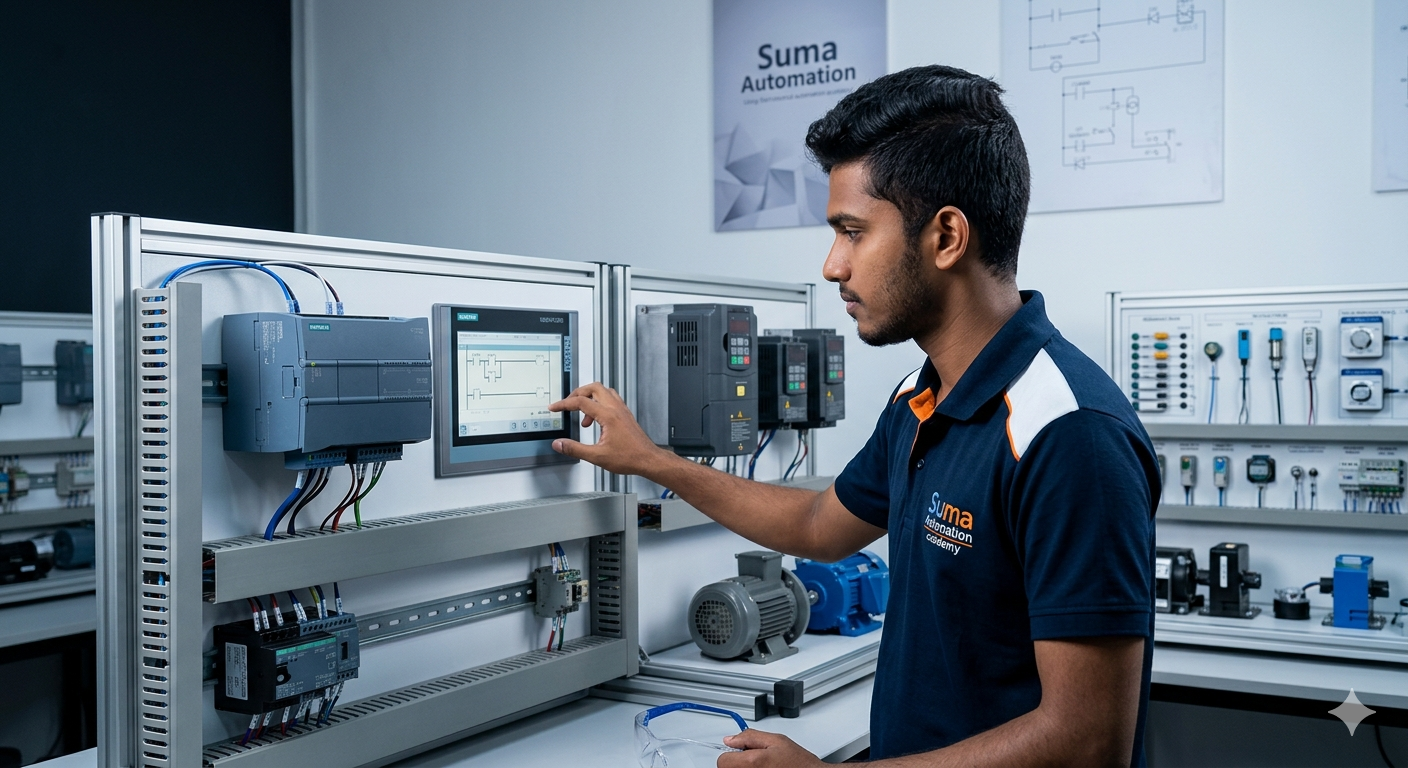
At Suma Automation, we provide hands-on experience with real industrial equipment used in modern factories. Our courses are designed to give you the practical confidence needed to design, program, and troubleshoot complex automation systems independently.
Why Should You Learn PLC Programming?
💰 High-Paying Global Careers
Automation engineers are in high demand in the Middle East, Europe, Singapore, and Australia, with salaries ranging from LKR 150,000 to LKR 500,000+.
⚙️ Hands-on Practical Mastery
Go beyond theory. Gain the ability to design, program, and troubleshoot complete industrial systems independently using real Siemens hardware.
🏭 Industry Demand & Job Security
Manufacturing facilities across Sri Lanka are rapidly automating. Skilled PLC programmers are in critically short supply, ensuring strong job security.
Our Teaching Methodology
100% Hands-on - Real Industrial Experience
🏢 Weekend Physical Sessions
Saturday or Sunday classes at our state-of-the-art training facility. 16 days of intensive practical training.
💻 Hybrid Learning Mode
Theory sessions online for working professionals, with all hardware sessions conducted physically.
Key Features:
- ✅ Individual workstation with Siemens S7-200/1200 PLC
- ✅ Real industrial hardware including VFDs, Servo Motors, HMI
- ✅ Live industrial projects
- ✅ Free retraining if not successful
- ✅ Career guidance and interview preparation
Industrial Equipment We Use
Our training facility features the same hardware found in modern factories:
🔌 PLC Systems
Equipment: Siemens S7-200 CPU 224, Siemens S7-1200, Expansion Modules
Training on TIA Portal, STEP 7-Micro/WIN software.
⚡ Variable Frequency Drives
Equipment: Siemens Micromaster, Delta VFD, ABB ACS
VFD Parameterization, Speed Control, PID Control, Modbus RTU communication.
🎯 Motion Control & HMI
Equipment: AC Servo Motors, Stepper Motors, Siemens KTP700 HMI
Precise Positioning, HMI Screen Design, Alarm Handling.
16-Day Complete Advanced Syllabus
📅 1. Fundamentals of Industrial Electronics
📚 Theory & Concepts
Industrial Electronics Review (90 min)
- Relays, contactors, logic gates, industrial switches and indicators
- Learning Objectives: Understand relay logic, Identify industrial components, Draw basic circuits
Introduction to PLC Systems (60 min)
- Overview of Siemens S7-200 series, PLC vs relay logic comparison
- Learning Objectives: Understand PLC advantages, Identify S7-200 models, Compare PLC vs relay
💻 Lab Exercises
Safety Circuits & Emergency Stops (90 min)
- Safety protocols, emergency stop circuits, overload protection
- Objectives: Design safety circuits, Implement emergency stops, Understand safety standards
🔧 Practical Work
Practical: Relay Control Panel (150 min)
- Build motor start/stop circuit with overload protection using physical relays
- Objectives: Wire relay circuits, Test safety features, Troubleshoot relay systems
📅 2. PLC Architecture & Basic Bit Logic
📚 Theory & Concepts
S7-200 Hardware Overview (90 min)
- CPU models, I/O modules, memory addressing, scan cycle explanation
- Learning Objectives: Identify PLC components, Understand addressing, Know scan cycle
Instruction: LD, LDN, = (Load, Output) (60 min)
- Basic contact and coil instructions, addressing syntax
- Learning Objectives: Use LD/LDN, Program outputs, Understand addressing
💻 Lab Exercises
STEP 7-Micro/WIN Software (90 min)
- Software installation, interface familiarization, project creation
- Objectives: Install software, Create projects, Navigate interface
🔧 Practical Work
Practical: Basic I/O Control (150 min)
- Wire buttons and lamps, program simple on/off control with seal-in circuit
- Objectives: Wire I/O devices, Program basic logic, Test and debug
📅 3. Series & Parallel Logic (AND/OR)
📚 Theory & Concepts
Instruction: A, AN, O, ON (AND, OR) (90 min)
- Series and parallel logic implementation, multiple conditions
- Learning Objectives: Use AND/OR logic, Combine conditions, Design complex logic
🔧 Practical Work
Practical: Two-Hand Safety System (120 min)
- Build safety circuit requiring two buttons pressed simultaneously
- Objectives: Implement safety logic, Test safety systems, Verify operation
Practical: Multiple Control Stations (90 min)
- Motor control from multiple locations with start/stop at each station
- Objectives: Wire multiple stations, Program OR logic, Test remote control
🤖 Hands-on Project
Project: Garage Door System (90 min)
- Combination AND/OR logic for door with safety sensors and remote control
- Objectives: Combine logic types, Design complete systems, Troubleshoot
📅 4. Set/Reset & Memory Circuits
📚 Theory & Concepts
Instruction: S, R (Set, Reset) (90 min)
- Memory retention, flip-flop circuits, dominant set/reset
- Learning Objectives: Use S/R instructions, Design memory circuits, Understand dominance
Instruction: P, N (Edge Detection) (60 min)
- Positive and negative edge detection for pulse generation
- Learning Objectives: Detect edges, Generate pulses, One-shot operations
🔧 Practical Work
Practical: Flip-Flop Circuits (120 min)
- Build RS flip-flop, JK flip-flop, and D flip-flop using PLC
- Objectives: Implement flip-flops, Test memory circuits, Verify operation
🤖 Hands-on Project
Project: Motor Forward/Reverse (120 min)
- Motor control with forward/reverse selection and interlocking
- Objectives: Program direction control, Implement interlocking, Safety features
📅 5. On-Delay Timers (TON)
📚 Theory & Concepts
Instruction: TON (On-Delay Timer) (90 min)
- Timer basics, presets, resolutions (1ms, 10ms, 100ms), timer addressing
- Learning Objectives: Understand timer types, Set presets, Choose resolution
🔧 Practical Work
Practical: Motor Soft-Start (90 min)
- Implement 5-second delay for motor soft-start sequence
- Objectives: Program time delays, Create start sequences, Test timing
Practical: Blinking Light (90 min)
- Create 1Hz blinking light using timer instructions
- Objectives: Create oscillations, Use timer contacts, Adjust frequency
🤖 Hands-on Project
Project: Star-Delta Starter (120 min)
- Complete star-delta starter simulation with timing sequence
- Objectives: Complex timing, Motor control sequences, Safety interlocks
📅 6. Off-Delay & Pulse Timers
📚 Theory & Concepts
Instruction: TOF (Off-Delay Timer) (90 min)
- Off-delay timing, applications in safety systems
- Learning Objectives: Use TOF timers, Safety applications, Programming techniques
Instruction: TP (Pulse Timer) (60 min)
- Fixed duration pulse generation, one-shot timing
- Learning Objectives: Generate pulses, Fixed timing, Pulse applications
🔧 Practical Work
Practical: Safety Light Control (90 min)
- Light stays on for 10 seconds after door opens
- Objectives: Safety lighting, TOF application, Real-world scenarios
Practical: Machine Lubrication (90 min)
- Pulse lubrication every hour for machinery maintenance
- Objectives: Maintenance timing, TP application, Scheduled operations
🤖 Hands-on Project
Project: Parking Gate Control (90 min)
- Complete parking system with entry/exit timing
- Objectives: System integration, Multiple timers, User interaction
📅 7. Counter Instructions
📚 Theory & Concepts
Instruction: CTU, CTD, CTUD (90 min)
- Up counters, down counters, up/down counters, counter addressing
- Learning Objectives: Use counters, Understand counter types, Address counters
🔧 Practical Work
Practical: Production Batch Counter (120 min)
- Count 100 pieces and stop production automatically
- Objectives: Batch counting, Auto-stop logic, Production control
Practical: Inventory System (120 min)
- Up/down counter for incoming/outgoing inventory tracking
- Objectives: Inventory tracking, CTUD application, Stock management
🤖 Hands-on Project
Project: Bottle Filling Station (90 min)
- Complete filling system with counting and batch control
- Objectives: Complete systems, Counting integration, Production automation
📅 8. Compare Instructions
📚 Theory & Concepts
Instruction: ==, <>, >, <, >=, <= (90 min)
- Comparison operators, data types for comparison
- Learning Objectives: Use comparisons, Understand operators, Data type handling
🔧 Practical Work
Practical: Temperature Control (120 min)
- Maintain temperature between 20-30°C with heating/cooling control
- Objectives: Range control, Process control, Setpoint management
Practical: Level Control (120 min)
- Tank level control with high/low alarms and pump control
- Objectives: Level monitoring, Alarm systems, Pump sequencing
🤖 Hands-on Project
Project: Speed Monitoring (90 min)
- Overspeed detection and shutdown system
- Objectives: Safety monitoring, Speed control, Emergency response
📅 9. Math Instructions
📚 Theory & Concepts
*Instruction: +I, -I, I, /I (90 min)
- Integer arithmetic, overflow handling, data type considerations
- Learning Objectives: Perform arithmetic, Handle overflows, Data type selection
🔧 Practical Work
Practical: Production Rate Calculation (90 min)
- Calculate average production rate per hour
- Objectives: Rate calculations, Averaging, Performance metrics
Practical: Totalization System (90 min)
- Sum daily production and calculate totals
- Objectives: Running totals, Data accumulation, Reporting preparation
🤖 Hands-on Project
Project: Mixing Tank Recipe (120 min)
- Calculate ingredient quantities based on batch size
- Objectives: Recipe scaling, Proportional control, Batch calculations
📅 10. Move & Conversion Instructions
📚 Theory & Concepts
Instruction: MOV, BCD_I, I_BCD, I_R, DI_R (90 min)
- Data movement, BCD conversion, integer to real conversion
- Learning Objectives: Move data, Convert data types, Understand BCD
🔧 Practical Work
Practical: Data Transfer System (90 min)
- Move data between registers for HMI communication
- Objectives: Register management, Data organization, HMI preparation
Practical: 7-Segment Display (120 min)
- BCD conversion for driving 7-segment displays
- Objectives: Display interfacing, BCD applications, Visual feedback
🤖 Hands-on Project
Project: Analog Scaling System (120 min)
- Convert 0-27648 analog input to 0-100% for display
- Objectives: Analog processing, Scaling calculations, Percentage display
📅 11. Rotate/Shift & Logical Operations
📚 Theory & Concepts
Instruction: ROL, ROR, SHL, SHR (90 min)
- Bit rotation and shifting operations
- Learning Objectives: Rotate bits, Shift bits, Bit manipulation
Instruction: ANDW, ORW, XORW (60 min)
- Word-level logical operations
- Learning Objectives: Word logic, Bit masking, Logical operations
🔧 Practical Work
Practical: Running Light Pattern (120 min)
- Create chasing light patterns using shift registers
- Objectives: Pattern generation, Shift applications, Visual effects
Practical: Fault Bit Masking (90 min)
- Use logical operations to filter and process fault bits
- Objectives: Fault handling, Bit masking, Error detection
🤖 Hands-on Project
Project: Pattern Generator (90 min)
- Complete pattern generation system for testing
- Objectives: Test systems, Pattern control, Flexible outputs
📅 12. Program Control Instructions
📚 Theory & Concepts
Instruction: JMP, LBL, CALL, SBR, RET (90 min)
- Program flow control, subroutine management
- Learning Objectives: Control flow, Use subroutines, Program organization
Instruction: FOR/NEXT (60 min)
- Looping structures for repetitive operations
- Learning Objectives: Create loops, Iteration control, Efficient programming
🔧 Practical Work
Practical: Alarm Handling Subroutine (120 min)
- Centralized alarm management using subroutines
- Objectives: Alarm systems, Subroutine design, Error handling
Practical: Maintenance Mode Jump (60 min)
- Implement maintenance mode using jump instructions
- Objectives: Mode switching, Conditional jumps, Maintenance procedures
🤖 Hands-on Project
Practical: Multiple Recipe System (120 min)
- Recipe selection and execution using program control
- Objectives: Recipe management, Mode selection, Process control
📅 13. High-Speed I/O & Interrupts
📚 Theory & Concepts
Instruction: HSC Configuration (90 min)
- High-speed counter setup and configuration
- Learning Objectives: Configure HSC, Understand modes, Setup parameters
Instruction: ATCH, DTCH, ENI, DISI (90 min)
- Interrupt attachment, detachment, enable/disable
- Learning Objectives: Manage interrupts, Event handling, Priority control
🔧 Practical Work
Practical: Encoder RPM Measurement (120 min)
- Measure motor RPM using encoder and high-speed counter
- Objectives: Speed measurement, Encoder interfacing, Real-time monitoring
Practical: Emergency Interrupt (90 min)
- Implement emergency stop using input interrupt
- Objectives: Emergency systems, Interrupt handling, Safety response
🤖 Hands-on Project
Project: Position Control System (90 min)
- Precise position control using encoder feedback
- Objectives: Position feedback, Closed-loop control, Precision systems
📅 14. PTO/PWM for Motor Control
📚 Theory & Concepts
Instruction: PLS (Pulse Output) (90 min)
- Pulse train output configuration, PTO/PWM modes
- Learning Objectives: Configure PTO, Understand PWM, Pulse generation
🔧 Practical Work
Practical: Stepper Motor Positioning (120 min)
- Control stepper motor with precise positioning
- Objectives: Stepper control, Position commands, Acceleration profiles
Practical: DC Motor Speed Control (120 min)
- Variable speed control using PWM output
- Objectives: Speed control, PWM applications, Motor regulation
🤖 Hands-on Project
Project: Servo Positioning System (90 min)
- Complete servo control with pulse train output
- Objectives: Servo control, Position feedback, Motion control
📅 15. Communication Instructions
📚 Theory & Concepts
Instruction: NETR, NETW (90 min)
- Network read/write for PPI communication
- Learning Objectives: PLC-PLC communication, Data exchange, Network setup
Instruction: XMT, RCV (Freeport) (90 min)
- Serial communication setup and management
- Learning Objectives: Serial communication, ASCII handling, Protocol implementation
🔧 Practical Work
Practical: PLC-to-PLC Data Exchange (120 min)
- Exchange data between multiple S7-200 PLCs
- Objectives: Multi-PLC systems, Data sharing, Coordinated control
Practical: Serial Communication with PC (120 min)
- Send/receive data to/from PC applications
- Objectives: PC interfacing, SCADA communication, Data logging
🤖 Hands-on Project
Project: SCADA Interface (60 min)
- Complete data exchange with SCADA system
- Objectives: System integration, Monitoring systems, Data visualization
📅 16. Integrated Final Project - Material Handling System
🤖 Hands-on Project
Implementation Phase 1: Input/Output (120 min)
- Implement sensor interface and actuator control
- Objectives: I/O integration, Sensor networks, Actuator control
Implementation Phase 2: Motor Control (120 min)
- Integrate stepper and servo motors for positioning
- Objectives: Motor integration, Positioning systems, Motion control
Implementation Phase 3: Communication & HMI (90 min)
- Add communication interfaces and HMI control
- Objectives: Communication systems, HMI integration, User interface
Why Choose Suma Automation PLC Course?
👨🏫 Industry Expert Instructors
Training delivered by Senior Automation Engineers with 10+ years of industrial experience.
🔧 Real Industrial Hardware
Hands-on experience with Siemens S7-200, S7-1200, VFDs, Servo Motors, and HMI Panels.
💼 100% Placement Assistance
Comprehensive career support including CV preparation, interview training, and industry networking.
🔄 Free Lifetime Support
Ongoing technical support even after course completion.
Course Prerequisites
- 📚 Basic Electrical Engineering knowledge
- ⚙️ Familiarity with industrial components (relays, contactors)
- 💻 Basic computer literacy
- 🤖 Strong interest in Industrial Automation
Start Your Automation Career Today
At Suma Automation, we provide more than just a certificate - we give you the real confidence to work in the industry.
Contact us for a free introductory session:
📞 Phone: 076 218 3549 📧 Email: info@sumaautomation.lk 📍 Location: Gampaha / Colombo, Sri Lanka
Limited seats available. Register early!
Frequently Asked Questions
❓ පාඨමාලාව සඳහා පූර්ව අවශ්යතා මොනවාද?
📌 මූලික විද්යුත් ඉංජිනේරු දැනුමක් තිබීම වාසියක්. Industrial Components (Relays, Contactors) පිළිබඳ මූලික හැඳිනීමක් තිබීම ප්රයෝජනවත් වේ.
❓ පාඨමාලාව සම්පූර්ණ කිරීමට කොපමණ කාලයක් ගතවේද?
📌 පාඨමාලාව දින 16කින් (සති 4-8) සම්පූර්ණ කළ හැක. සෑම දිනකම පැය 8 බැගින්. සම්පූර්ණ පැය 128ක ප්රායෝගික පුහුණුවක්.
❓ වාරික වශයෙන් ගෙවීමේ පහසුකම් තිබේද?
📌 ඔව්, පාඨමාලා ගාස්තුව වාරික 2ක් හෝ 3ක් වශයෙන් ගෙවීමේ පහසුකම පවතී.
❓ What hardware will I work with during the course?
📌 You will work with real industrial hardware including Siemens S7-200 and S7-1200 PLCs, Variable Frequency Drives (VFDs), AC Servo Motors, Stepper Motors, and HMI Panels.
Ready to Start Your Journey?
Join our professional training programs and become an industry-ready engineer.
Was this article helpful? Share it with others